Breaking Bad's Final Lesson...
...and the lies we tell ourselves.


The Real Villian… is Pride.
For most of Breaking Bad, Walter White believes he is the hero of his own story - and so do we.
A brilliant chemist overlooked by the world. A husband and father dealt an impossibly cruel hand. A man willing to sacrifice everything for the people he loves.
It’s a narrative that Walter tells everyone around him, but more importantly, it’s a narrative he tells himself. The genius of Breaking Bad is that it spends five seasons slowly dismantling that story piece by piece.
Every opportunity to walk away is refused. Every compromise becomes another step deeper into darkness. Every justification grows thinner. By the final season, the show is no longer asking whether Walter White is a good man.
It is asking whether he is finally willing to confront the truth about himself…and his pride.

The Death of Heisenberg
Walter’s defining flaw was never greed. It was pride.
From the very beginning, Walter is presented with alternatives. Gretchen and Elliott offer him financial help. Legitimate opportunities arise to provide for his family. Time and again, there are exits available to him. Yet Walter refuses them all.
The reason is not necessity. It is pride. Accepting help would mean admitting failure. Walking away would mean accepting limits. Remaining anonymous would mean accepting a life that fell short of his ambitions.
The drug empire is not simply a source of income. It is the first place Walter feels respected. Significant.
That is why his confession to Skyler in the finale lands with such force. When he admits, “I did it for me,” it is the first truly honest thing he has said in years. The audience already knows it. Skyler knows it. Deep down, Walter has known it too. But for the first time, he stops hiding behind the mask of self-sacrifice and accepts what has always been driving him.
Ironically, that moment of honesty allows him to do the one thing he claimed he wanted all along.
Provide for his family.
Walter realises there is no future in which his son willingly accepts money from him. The White family can only move forward if Heisenberg remains buried. And so Walter does something that would have been impossible for him earlier in the series. He allows somebody else to take the credit. Gretchen and Elliott become the vehicle through which the money reaches Walt Jr., while Walter himself remains invisible.
For a man whose entire journey has been fuelled by a desperate need for recognition, it is a profound act of surrender. The money survives. The family survives.
But the legacy belongs to someone else.

Jesse Pinkman: The Boy Looking for a Father
While Walter’s story is about pride, Jesse’s is about belonging.
Throughout the series, Jesse repeatedly searches for father figures. He craves approval, guidance, and the reassurance that someone believes in him. His biological parents reject him. Walter manipulates him. Mike becomes the closest thing Jesse ever finds to a genuine mentor, only to disappear from his life as well. Again and again, Jesse forms attachments to older men who ultimately abandon him.
Underneath the bravado and self-destruction is a frightened young man desperate to feel valued.
Viewed through that lens, the final episodes take on a different meaning. Jesse’s captivity at the hands of Jack’s gang is not simply physical imprisonment. It is the culmination of a lifetime spent under the control of others. Every major relationship in his life has left him trapped in one way or another.
Which is why Walter’s return matters.
Not because it redeems him. Nothing can erase the years of manipulation, betrayal, and emotional abuse. Walter remains deeply responsible for much of Jesse’s suffering. Yet when Walter returns to the compound, his motivations are different. Jesse is no longer useful. There is no money to be made. There is no empire left to protect.
For perhaps the first time in the series, Walter acts with Jesse’s interests ahead of his own.
The moment that follows is even more important. Walter offers Jesse the gun and effectively gives him permission to kill him. Earlier versions of Jesse might have done it. They might have sought closure through revenge or validation through Walter’s approval. But Jesse refuses.
It is a subtle but powerful rejection.
Jesse finally stops defining himself through the expectations of father figures. He no longer needs Walter’s approval, Mike’s guidance, or anyone else’s permission to choose his own path. When he drives away from the compound in the final moments of the series, he is not simply escaping captivity.
He is escaping the need to belong to someone else.
For the first time in his life, Jesse is free.

Skyler White: Living With the Consequences of Pride
Skyler is often discussed as a supporting character in Walter’s story, but by the final season it becomes clear that she is one of the show’s greatest victims.
Where Walter’s pride drives the narrative forward, Skyler is left to live with the consequences of it. She spends years trying to rationalise the irrational, convincing herself that cooperation is the safest option and that some version of her family can still survive. Like Walter, she becomes trapped by denial. The difference is that Walter derives power from the lie, while Skyler is slowly destroyed by it.
By the finale, there is nothing left to salvage.
The White family has been shattered. Hank is dead. Walter Jr. despises his father. Skyler exists in a state of exhaustion and quiet grief. When Walter visits her one last time, the scene is remarkable for what it does not attempt to do. There is no reconciliation. No rekindling of affection. No suggestion that things can be repaired.
Instead, there is only the truth.
Walter finally gives Skyler the honesty she deserved years earlier. In return, she gives him something equally important: acknowledgement that the performance is over.
Their marriage ended long before the finale. This scene simply allows both characters to stop pretending otherwise.
Hank Schrader: The Other Side of Pride
Walter is not the only proud man in Breaking Bad.
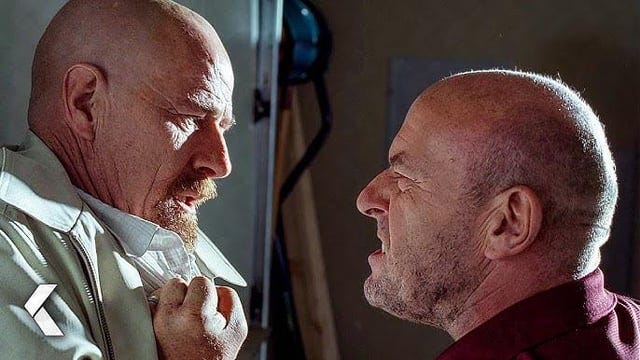
Hank Schrader is driven by pride as well, but his pride manifests very differently. Walter’s pride is rooted in ego. It tells him that he deserves more than the life he has been given. Hank’s pride is rooted in duty. It tells him that some things are worth standing for, regardless of the consequences.
Yet both men share the same inability to back down.
As the final season progresses, their collision becomes inevitable. Walter cannot surrender because doing so would mean accepting defeat. Hank cannot compromise because doing so would betray everything he believes in. Neither man is willing to abandon the principles that define him.
The tragedy of the desert confrontation is that both characters are, in their own way, exactly who they have always been.
Walter’s pride built an empire. Hank’s pride brought him to its doorstep. And neither could survive the encounter.

Why Ending Worked For Me
Many television finales attempt to redeem their protagonists. Breaking Bad understands that redemption is not always possible.
Walter cannot undo the lives he destroyed. Jesse cannot recover what was taken from him. Skyler cannot rebuild the family she lost. The show never pretends otherwise.
Instead, it offers something more honest: Recognition.
The ending works because every major character finally sees themselves clearly.
Walter stops hiding behind excuses. Jesse stops searching for validation. Skyler stops clinging to illusions. Even Hank, in his final moments, refuses to become someone he is not.
The truth emerges, and the consequences are laid bare for all to see.
Final Thoughts
At the beginning of Breaking Bad, Walter White believes his tragedy is that the world never recognised his greatness.
By the end, he discovers something far more painful.
His greatest enemy was never cancer. It was never Gus Fring, the cartel, or the DEA.
It was the part of himself that needed to be recognised in the first place.
And tragically - only when he finally lets it go does he accomplish the one thing he claimed he wanted all along: providing for his family without needing anything in return.